About Ein Harod Apiary
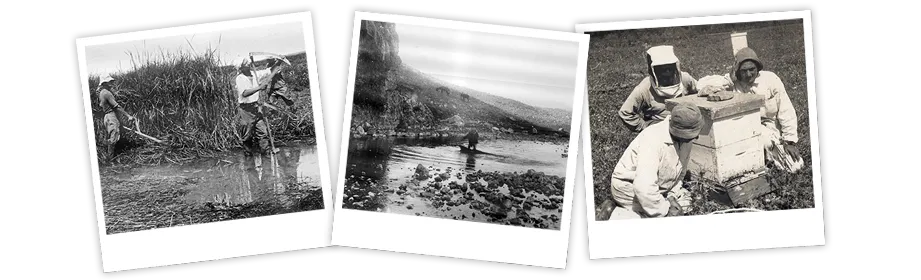
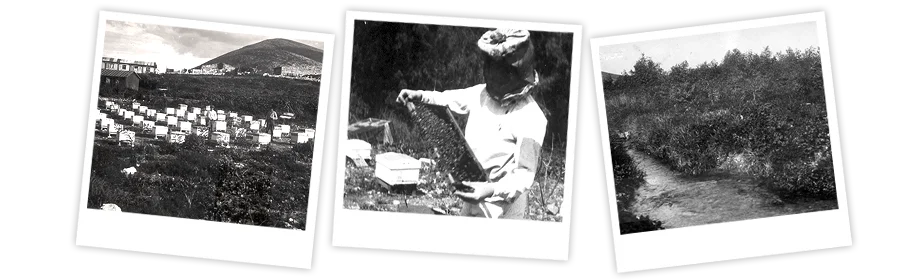
The Ein Harod Apiary was established on 1922 in Kibbutz Ein Harod, located in the Jezreel valley near Harod spring, the biblical site of Gideon's spring.
The original Kibbutz settlements, established in the early 20th century, were agriculturally oriented. Today, although most Kibbutz settlements are still extensively involved in state-of-the-art agriculture, they are also involved in industry, technology and tourism/hospitality.
Our specialist beekeepers take our hives to the best flowers in areas where they are most plentiful. We produce and package our honey products in compliance with the strictest quality control standards.
Certificates
The actual gathering of honey from the hives is carried out at a state-of the-art packaging plant. The Ein Harod Apiary operates under the supervision of the Ministry of Health. We comply with the most stringent ISO 9001, HACCP and FSSC 22000 standards and our products are Kosher-certified by the Orthodox Council of Jerusalem Supervision.
Our range of different honey types
We produce 100% pure honey with absolutely no additives, preservatives or sugars.
Cleanliness is achieved through meticulous filtration, and the final product is marked as either liquid or crystallized honey.
- Citrus blossom honey
- Wildflower honey
- Avocado blossom honey
- Starthistle blossom honey
- Siziphus (Middle Eastern Acacia) blossom honey
- Eucalyptus blossom honey
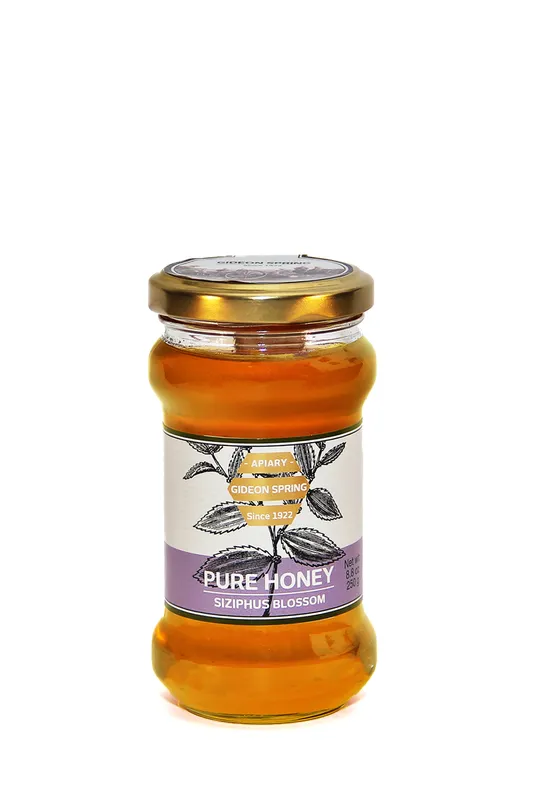
Jesus, the Temple, the Siziphus Tree & Honey from Ein Harod
The flowers of the siziphus tree stand out as one of the finest sources of nectar collected by the honeybees and converted into pure honey in the beehives of the Ein Harod Apiary. Sisyphus trees grow mainly in the desert, namely - in the Negev region and the Jordan Valley. The flowers produce a pleasing aroma and a particularly sweet nectar.
The sisyphus tree is featured prominently in the Holy Scriptures. For example, siziphus branches were used for building the Holy Ark of the Tabernacle at the Temple in Jerusalem: "And thou shalt make staves of shittim wood, and overlay them with gold." (Exodus 25:13).
According to commentary, the wreath of thorns placed on the head of Jesus before the crucifixion, was made from siziphus branches: "And when they had platted a crown of thorns, they put it upon his head …" (St. Mathew 27:29).
The vision of redemption recounts that the siziphus tree is one of the trees that makes the desert bloom: "I will plant in the wilderness the cedar, the shittah tree, and the myrtle, and the oil tree; I will set in the desert the fir tree, and the pine, and the box tree together." (Isaiah 41:19).
About Honeybees
Drones
Male bees or “drones” have no sting at all...
They also do not work (actually, their task is to fertilize the queen bee's eggs, but this cannot count as work … because the drones die while doing it).
Worker-bees
The life span of a worker-bee is 6 weeks only, and it can fly to distances of up to 6 miles.
Worker-bees can only sting once - which is why they're in no hurry to do so.
Beekeepers often handle their bees without gloves, and the bees just go on about their business.
Queen bees
Queen bees live up to 4 years and can lay 1,500 to 4,000 eggs a day.
- A bee can carry her own weight in nectar and pollen and still fly.
- Bees live a crowded and highly efficient life where each bee fulfills a specific function or task.
- Some bees scout the fields for nectar and pollen.
- Other bees are charged with the task of aerating the beehive, especially during the hot days of summer.
- Yet each and every bee can quickly change her role and help with other tasks.
Bees are intriguing, cute and fun to watch.